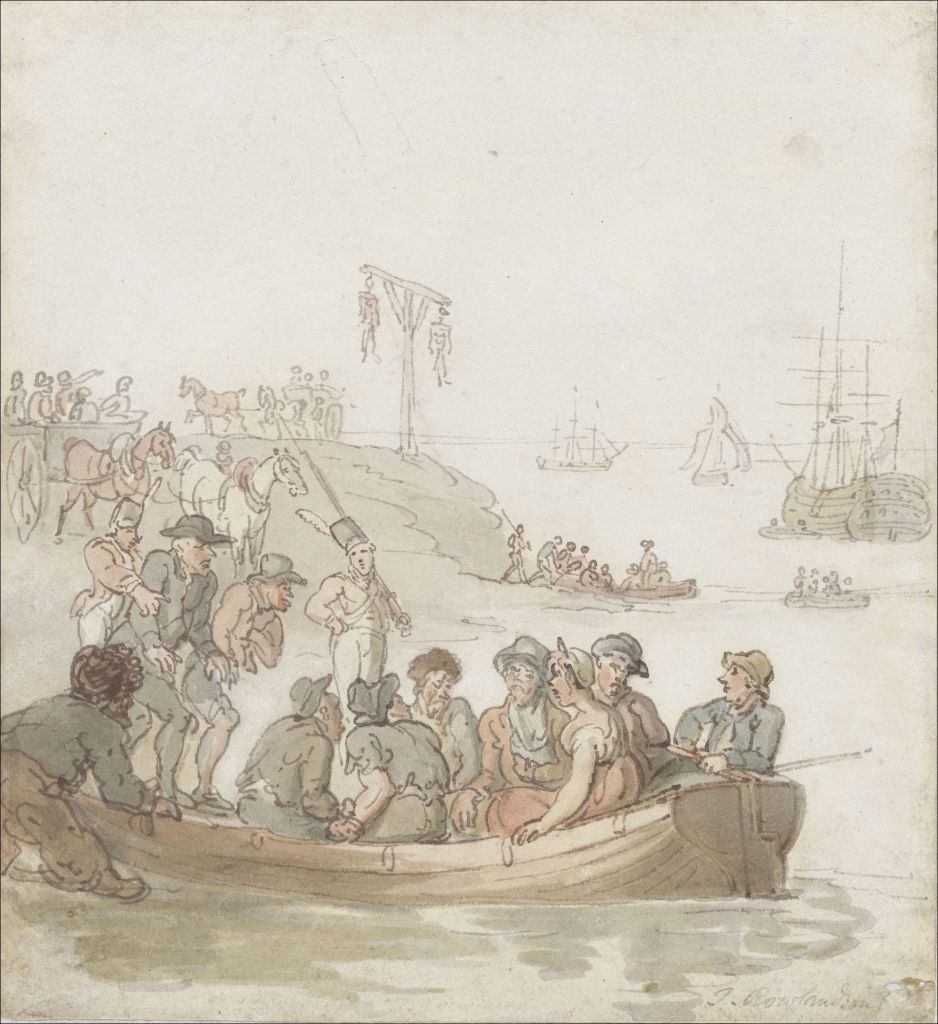
Sarah Bentley’s background and parentage are unknown but in July 1795, aged sixteen, she was in service with Mr & Mrs John Taylor who lived in Highgate, England, then a village about five miles from London.
On 25 July 1795, for reasons which will foreever remain a mystery, Sarah ran away to London, taking with her two dresses and some other items of clothing belonging to her mistress. She tried to pawn one of the dresses to obtain some funds but the pawnbroker became suspicious because the dress was not her size. He called a Constable and by evening Sarah was behind bars in New Prison, Clerkenwell.
On 10 September 1795 Sarah was transferred to Newgate Prison which adjoined the Old Bailey, the main trial court in London and on 16 September she was tried, found guilty of grand larceny and sentenced to seven years transportation. The items she had stolen were worth $87.00 in todays money.
On 28 October 1795 Sarah was delivered to the Indispensible, a convict transport which would shortly set sail for Botany Bay (Sydney) carrying one hundred and thirty three female convicts. After a five and a half month voyage which the women would have spent mainly below decks in a specially constructed prison, the Indispensible arrived in Sydney on 30 April 1796.
Upon arrival Sarah was sent fifteen miles inland to Parramatta where a second settlement had been established. As a convict she was obliged to work and she was probably assigned to someone as a servant, but men outnumbered women four to one in the colony and almost all the women who had arrived on the Indispensible were soon either married or living with a partner. On 16 September 1796 Sarah married John Warby, a farm labourer from Hertfordshire who had arrived on the Pitt in February 1792.
John was hardworking and ambitious. In 1801, by then an emancipist, he purchased a fifty acre farm at Prospect Hill, about five miles from Parramatta. In 1811 Governor Macquarie granted him 260 acres of land at Airds and he sold the Prospect Hill farm and concentrated on developing it. He gradually acquired more land until by the time of the 1828 census, he owned 900 acres adjoining Campbelltown, the town which Macquarie had established in Airds in 1820.
Today we struggle with the fact that the British pushed the Aboriginals, the original inhabitants of the country, off their land so that they could establish farms, but two hundred years ago the British did not see it as wrong. They believed that they were offering the Aboriginals a gift, the chance to adopt the British way of life, which would include becoming farmers in their turn when they were ready to do so.
Sarah gave birth to fourteen children: Edward (b. 1800), William (b. 1801), Elizabeth (b. 1802), John Junior (born 1803), Benjamin (b. 1805), Sarah Junior and Jane (b. 1806), Charles (b. 1810), Mary (b. 1813), Robert (b. 1814), Eliza (b. 1816), James (b. 1817), Joseph (b. 1818) and Richard (b. c. 1821). Edward died young, John Junior died unmarried at the age of twenty-two and Richard died in infancy but the remaining eleven children grew up and married and had children of their own.
Sarah and Warby lived blameless lives in the colony. By 1850s they had some of the trappings of wealth, including a phaeton to drive around in, and the fact that they had arrived as prisoners of the Crown was rarely mentioned, although it was never entirely forgotton by free settlers who no matter how lowly their background considered themselves a cut-above the emancipists.
Warby died in 1851, aged about eighty-one. Sarah lived on until 1869 when she died at the home of her son Joseph, aged eighty-nine. She was buried in the family plot in St Peter’s Anglican Cemetery in Campbelltown where her husband and her son John Junior had earlier been buried.
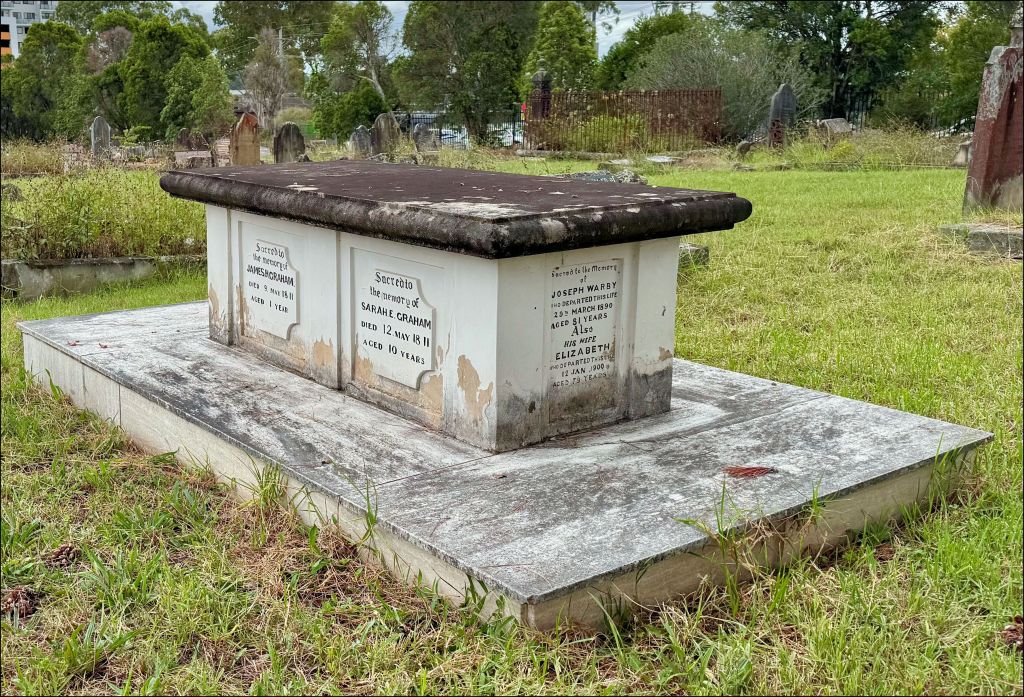
Sarah has thousands of descendants, most of whom live in Australia but some of whom live in many different countries around the world. Her descendantsview her with pride.
Further reading:
Michelle Vale, Warby, My Excellent Guide, 1994, which focuses on John Warby’s exploits and contains accounts of the lives of the eleven children who grew up and married together with extensive ancestral charts. Out of print. Copies are held in the National Library of Australia and some public libraries such as Campbelltown City Library, Campbelltown, New South Wales.
J Houtzaager, Sarah’s Journey, 2026, which focuses on bringing Sarah to life. Available on Amazon as a print book or in a kindle version.
 Exploring the past
Leave a comment