What follows is the bare bones of Ann Crouch’s story. A little imagination could lift her off the page and have her walking among us. Time allowing, I will do this for you one day Ann.
Ann Crouch was born in Broxbourne, Hertfordshire in about 1791, the eldest child of John Crouch, a brewer and his wife Mary Reed. Nothing is known about her early life but she never learned to read and write and probably went into service young.
Ann eventually moved to Hertford, the county capital. In late 1814 she was working as a cook for Benjamin Rooke, a Hertford attorney but her life was was about to take a sharp turn for the worse. Unmarried and pregnant, she fell prey to the temptation to steal from her employer.
On 1 January 1815 Ann was arrested and taken to Hertford Goal. She was charged with stealing eight quart bottles of beer and one quart bottle of gin and was tried at the Epiphany Borough Sessions in Hertford on 11 January 1815. Rooke and his housekeeper Julia Smith gave evidence against her and she was found guilty of larceny and sentenced to seven years transportation.
In June 1815 Ann gave birth to a baby boy in Hertford Goal. Called Benjamin, he was baptised at All Saints Anglican Church, Hertford on 25 June 1815. No father was named in the baptismal record, and the word ‘Illegitimate’ was written beneath the entry. Ann’s place of residence was given as Hertford Goal.
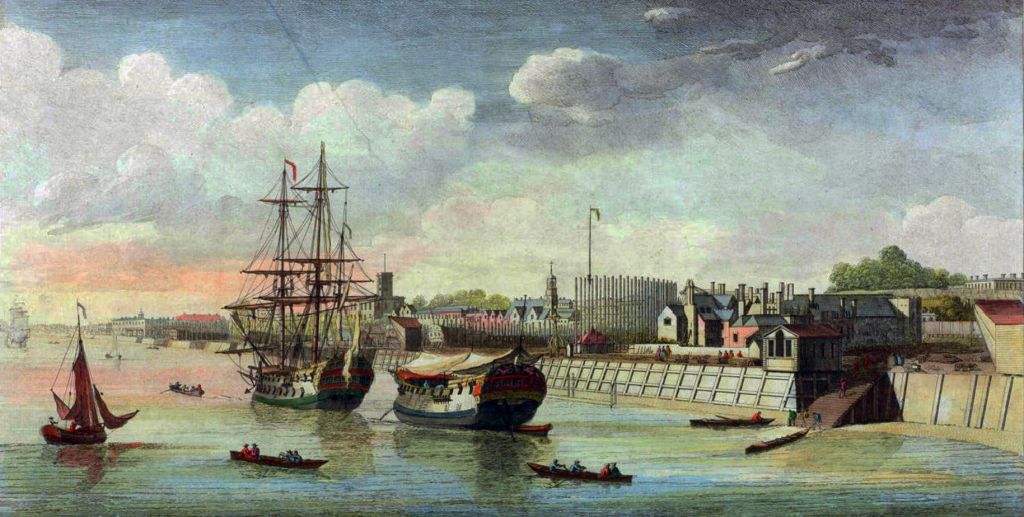
A fortnight later Ann was taken by coach to Woolwich, London and delivered to the convict transport Mary Ann. Benjamin was left behind with relatives in Butcherly Green, a poor suburb of Hertford.
The Mary Ann sailed on 21 July 1815 with 103 female convicts on board and after an unremarkable voyage of nearly six months arrived at Port Jackson on 19 January 1816. Upon arrival the convicts were mustered on deck and their appearance and any distinguishing marks were recorded. Ann was 5’3” tall with brown hair, hazel eyes and a sallow [unhealthy yellowish] complexion.
After the muster the women were distributed among the government officials, free settlers and emancipists who had applied for a servant. Ann was assigned to Gregory Blaxland, a wealthy free settler, but it was not long before her circumstances changed; on 1 July 1816 she married Thomas Terry at St John’s Anglican Church in Parramatta.
Terry had been convicted of burglary in London in 1810 at the age of eighteen and sentenced to death, which had later been transmuted to transportation for life. He had arrived in the colony on the Guildford in 1812 and had lived a blameless life ever since, working as a servant for John Drummond and William Guise.
For a while, things went well. Ann had children: Emma, born in April 1817; Joseph, born in May 1819; and Thomas Junior, born in April 1821. Terry was approved for a Ticket of Leave in 1817 on the recommendation of his masters and became the lessee of a small farm where he began growing wheat, barley and oats and keeping hogs. In 1821 he applied for a Conditional Pardon.
Then on 21 August 1823 Terry died, aged just 30. Ann was pregnant and gave birth to a daughter, Elizabeth, on 25 January 1824 but the baby died in December 1824 when she was ten months old.
Ann’s sentence had expired in January 1822 which meant that she was eligible to apply for convict servants of her own. In 1825 she applied for a farm servant and was assigned Thomas Collins, an Irish convict who had been sentenced to seven years transportation for picking pockets and who had arrived on the John Barry on 10 November 1821.
On 25 December 1827 Ann gave birth to a third daughter, Bridget. When Bridget was baptised, Collins was named as her father but she was always known as Bridget Terry.
When the census was conducted in November 1828 Ann was living on her farm with Collins, Emma, aged eleven, Joseph, aged nine, Thomas Junior, aged seven and Bridget, who was just under a year old. She had twenty four acres under cultivation, owned two horned cattle and was described as a ‘Settler’. However, once a convict always a convict; the name of her ship and the length of her sentence also appeared next to her name.
Ann died on 12 July 1867. She and Collins were married on 22 June 1867, before her death, when an Anglican minister came to the house and performed the ceremony. Why they did not marry earlier can only be speculated about. Perhaps Ann did not want to convert to Catholocism; perhaps Collins had left a wife behind in Ireland; or perhaps it was for some other reason entirely. In the Death Notice which her family placed in the newspaper she was described as Ann Collins, relict of the late Thomas Terry.
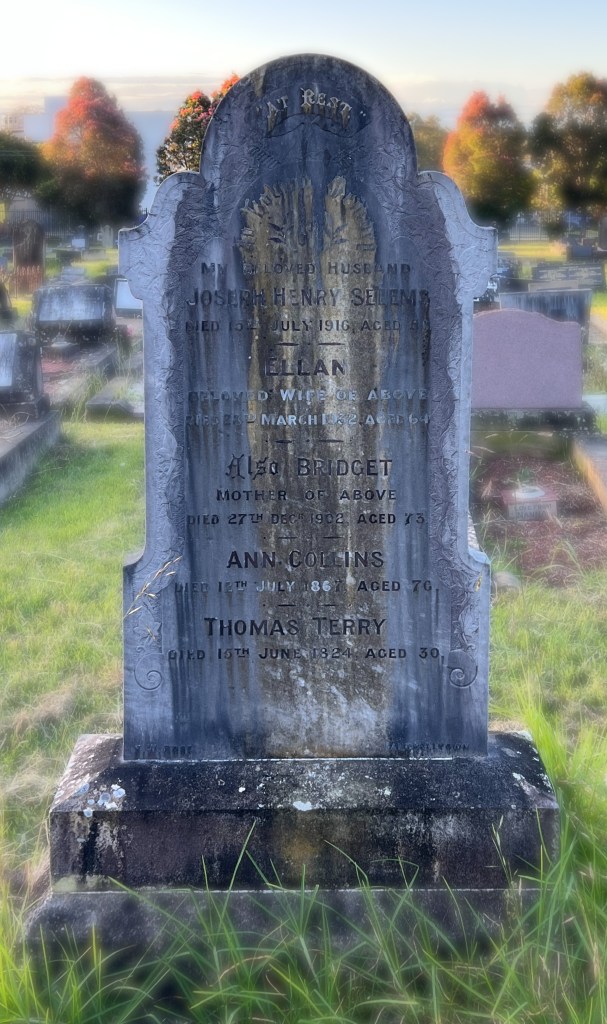
Ann was buried in St Peter’s Anglican Cemetery in Campbelltown in the same plot as her first husband. In due course Bridget, Bridget’s son Joseph Selems and Joseph Selems’ wife Ellan would also be buried there and a marble headstone would be erected commemorating them all. Terry’s date of death on the headstone is wrong, perhaps not surprisingly as it is likely that it was erected more than one hundred years after his death.
In 1815 Ann had been separated from her family in England, including her baby, and transported to the other side of the world for a crime which today would not even see her imprisoned, but she had survived and had lived a law-abiding life in the colony. Her son Joseph married but had no children but Emma, Thomas Junior and Bridget all married and had large families and Ann has thousands of descendants in Australia today.
Although Ann survived and lived a long life, Benjamin did not. He was buried at All Saints Anglican Church in Hertford on 3 December 1815, before Ann’s ship even reached Australia, his burial recorded by the man who had baptised him less than six months earlier. Whether Ann ever knew of his death, or whether she hoped against hope all her life that he had lived and thrived, will never be known.


Leave a Reply