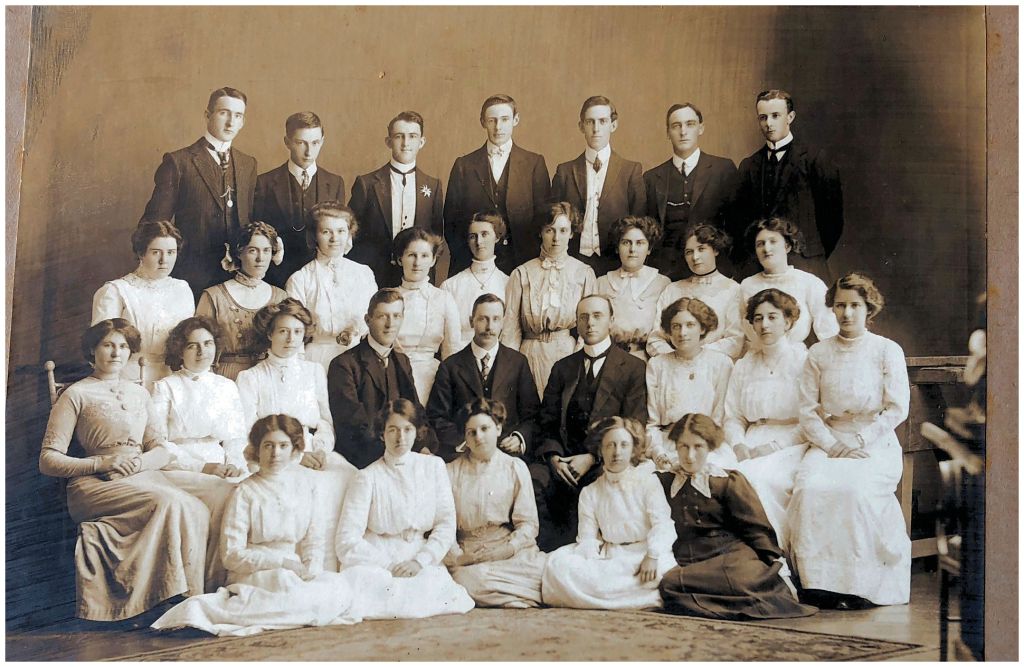
It was only after I retired in 2021 that I discovered, nestled among the photographs albums which had passed to me upon the death of my Aunt Alison in 2015, an album of a different kind; an autograph album which had belonged to my grandmother Gwen Terry, formerly Gwen Davies, who died in 1986.
My grandmother never mentioned the album, but there is no doubt that it was hers. Among other things one of the verses in the album begins ‘Gwen, oh Gwen, shall I tell you when…’.
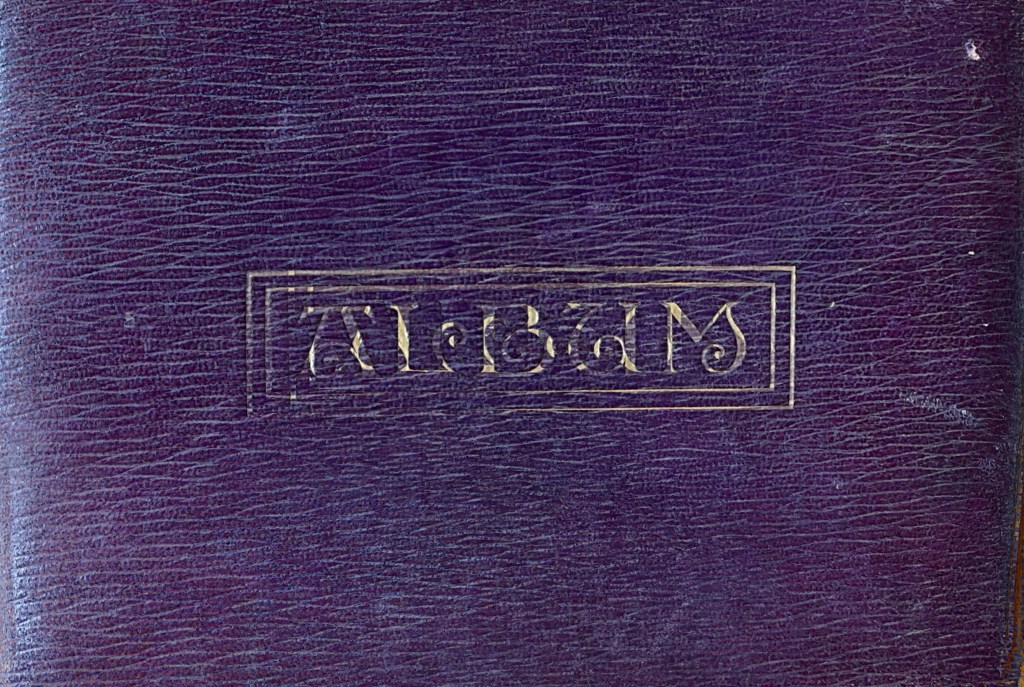
The album is 7 inches by 5 inches and has a dark brown bonded leather cover. Bonded leather is made by mixing leather fibres with a polyurethane binder and is commonly used in bookbinding. The word ‘ALBUM’ is embossed on the cover in gold letters, and inside are a quantity of gilt edged pages of reasonably thick paper, all originally blank, in three colours intermixed throughout the album: light pink, ivory and a light powder blue.
Inside the front cover are the words ‘JOHN WALKER & Co Ltd, of Farringdon Street Warwick Lane E.C.’ They were publishers and wholesale manufacturing stationers who were still in business in 1910 when the first entry in the album was made and the album must have been imported.
The album has seen better days; the cover has a few dents and scuff marks and the pages have come partially loose from the binding and are somewhat discoloured. However, it must have looked lovely when new, and I wonder whether it was given to my grandmother as a birthday or Christmas present.
Most of the entries in the album were made between February 1910, when my grandmother commenced her final year of high school at Sydney Girls High School, and October 1912, when she finished her course at Sydney Teacher’s College.
It is not easy to find examples of autograph albums from this or indeed any period in museums, unless they happen to have belonged to or contain the signatures of celebrities, artists or sports stars. I found a comparable album in the Surrey Hills Neighbourhood Centre Heritage Collection, and a detailed description of a similar one on a webpage created by Warren Fahey, but the place they are mostly found is on sites like eBay. They sell for around $50.00, although exceptional ones sell for more.
Their prevalence on eBay suggests two things; one, that they were once very popular, and two, that some people like to collect them.
It was immediately apparent when I looked at the Warren Fahey web page, the album in the Surrey Hills Neighbourhood Centre Heritage Collection and the albums on eBay of similar vintage to my grandmother’s that the entries in her album are typical of the period.
There are pithy sayings (for example ‘What is, is! (Shakespeare)); exhortations to be of good cheer; and comic verses about relationships with men. Written vertically on the edge of the back cover are words that seem almost ubiquitous: ‘By hook or by crook I’ll be last in this book.’
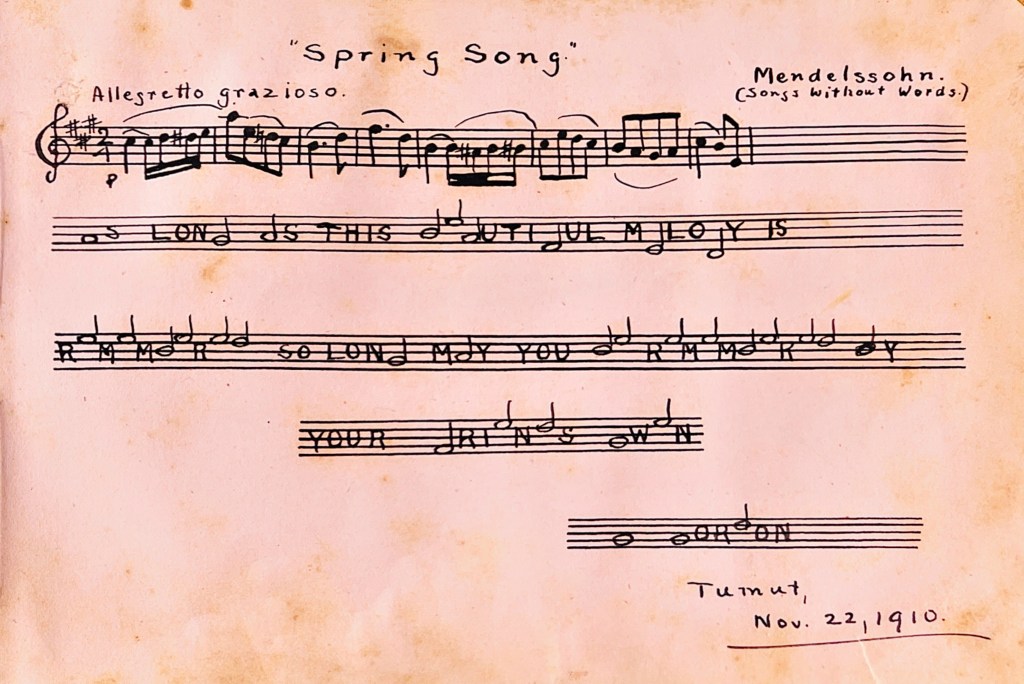
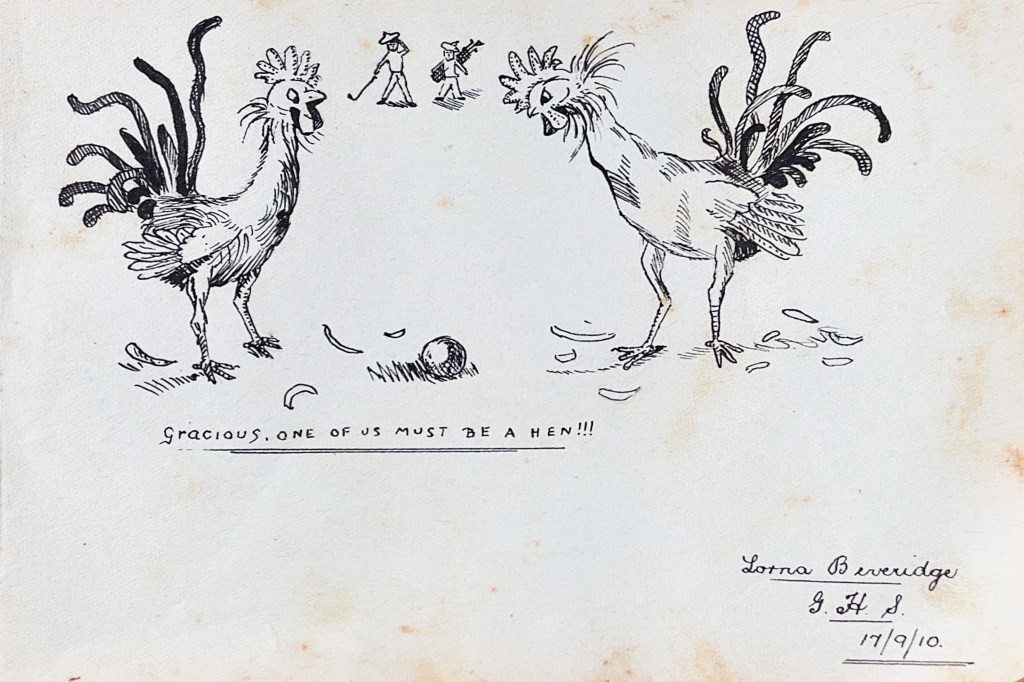
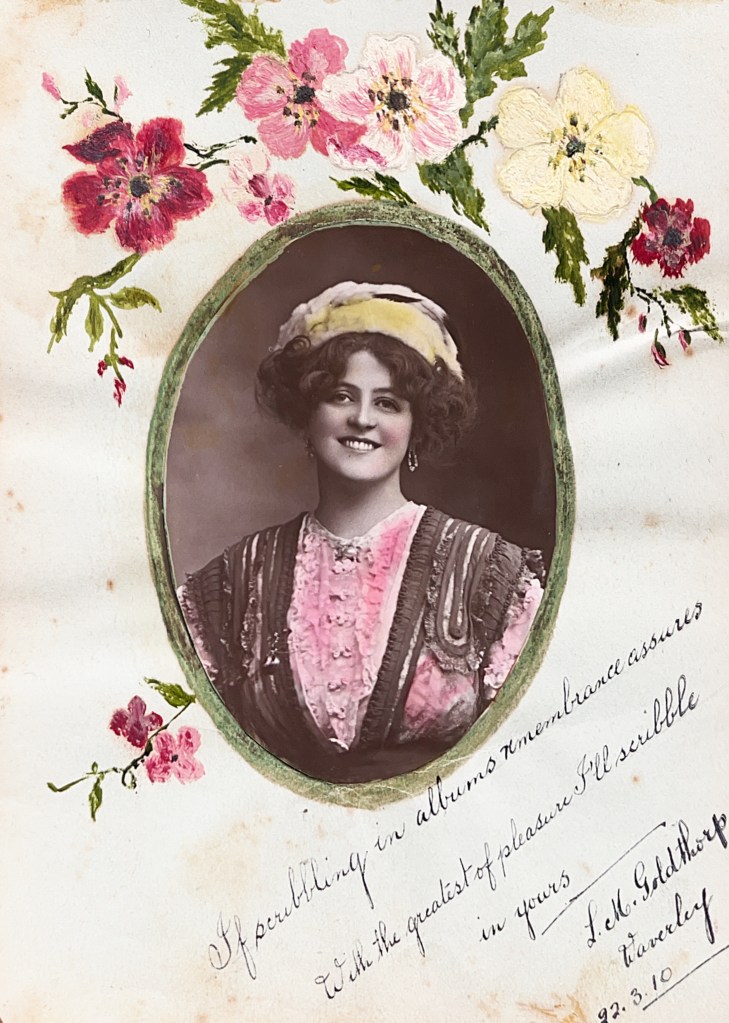
Many of the entries are short, but some are a page or two long and some must have taken considerable artistic effort. There is an autograph disguised within a musical score; several hand drawn cartoons, one of which is reproduced below and a page containing hand-painted flowers onto which a photo has been pasted.
One page contains the signatures of what may well be every member of my grandmother’s graduating high school class of 1910, artistically grouped on a painted flower background.
The significance of the album to my grandmother between 1910 and 1912 is easy to deduce. Autograph albums were popular, so she was following a trend which linked her with her friends. Collecting the entries would have been fun, as would making entries in other people’s books. Some contributors used it as a chance to show off their artistic skills, in the same way that people use Instagram today. Other contributors, probably older, chipped in advice for the feckless young person about the value of working hard and accepting their lot in life.
My grandmother ceased to use the book for any social purpose at the end of 1912. The only entries after that are one dated 5 July 1913 made by her future husband Frank Terry, and four made on much later dates by her children Margaret, Colin and Alison.
The last time I can be sure my grandmother looked at the book was in October 1939 when her daughter Alison, aged 9, wrote the last entry. Whether she just glanced at it then or read it through carefully I cannot know, but it must have brought back memories, some happy and some sad.
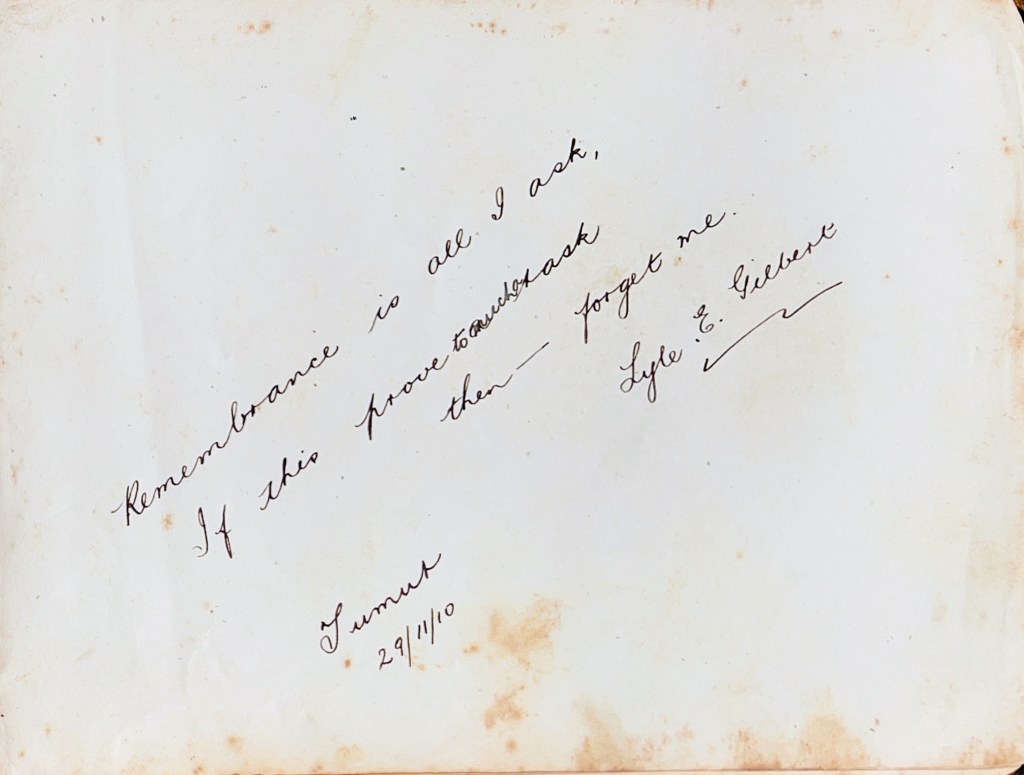
On a whim I checked the National Archives for any reference to Lyle E. Gilbert, the man who wrote the entry below. It turned out that he enlisted in the AIF in 1916 and was killed in action in August 1918. He was the same age as my grandmother and also became a teacher. It seems likely that she would have known his fate.
My grandmother must have valued the album as a nostalgic piece of her past because she kept it safe among her photograph albums until she died in 1986.
I value it as well, for several different reasons.
First, some of the entries intrigue me and I would like to investigate them further. One contribution, by someone whose name I cannot yet decipher, is a lengthy extract from a work by R Green Ingersoll called ‘Liberty of Man, Woman and Child’. Upon googling that name, I discovered that he lived from 1833 to 1899 and was known as ‘The Great Agnostic’. My great grandfather was a Presbyterian minister, and my grandmother was a devout Presbyterian all her life. There must be a story behind that entry.
Second, it provides an interesting insight into some of the attitudes and beliefs prevailing between 1910 and 1912.
Third, it contains a page long entry in the hand of my great grandmother Maggie Davies, the only example of her handwriting I have ever seen. Maggie was born in Merthyr Tydfil in 1855, married Richard Davies in Pontypridd in 1887 and emigrated to Australia with him shortly afterwards.
Finally, it is particularly precious to me because as I turn over the pages I think about my grandmother: both as I knew her, a white haired lady who patiently answered my questions about the family; and as she was between 1910 and 1912, a lovely young girl about to begin her adult life.
 Exploring the past
Leave a comment