Alexander Macdonald, felon and farmer, was born in Scotland in about 1796, the son of Margaret Reid and an unknown father. He received no schooling and was not bred to a trade.
By 1811 Alexander was living with his mother and her husband John White, a baker, in Weirs Close, Canongate, Edinburgh. Unfortunately, his mother was supplementing the family income by receiving and selling stolen goods, which did not set him on the path to becoming a law abiding citizen. Late on New Years Eve and during the early hours of New Years Day 1811/12 he was one of a large number of youths who roamed the streets of Edinburgh near the Tron Kirk, knocking down Gentleman returning home from New Years Eve celebrations and robbing them of their hats, handkerchiefs, watches, purses and anything else they had in their pockets.
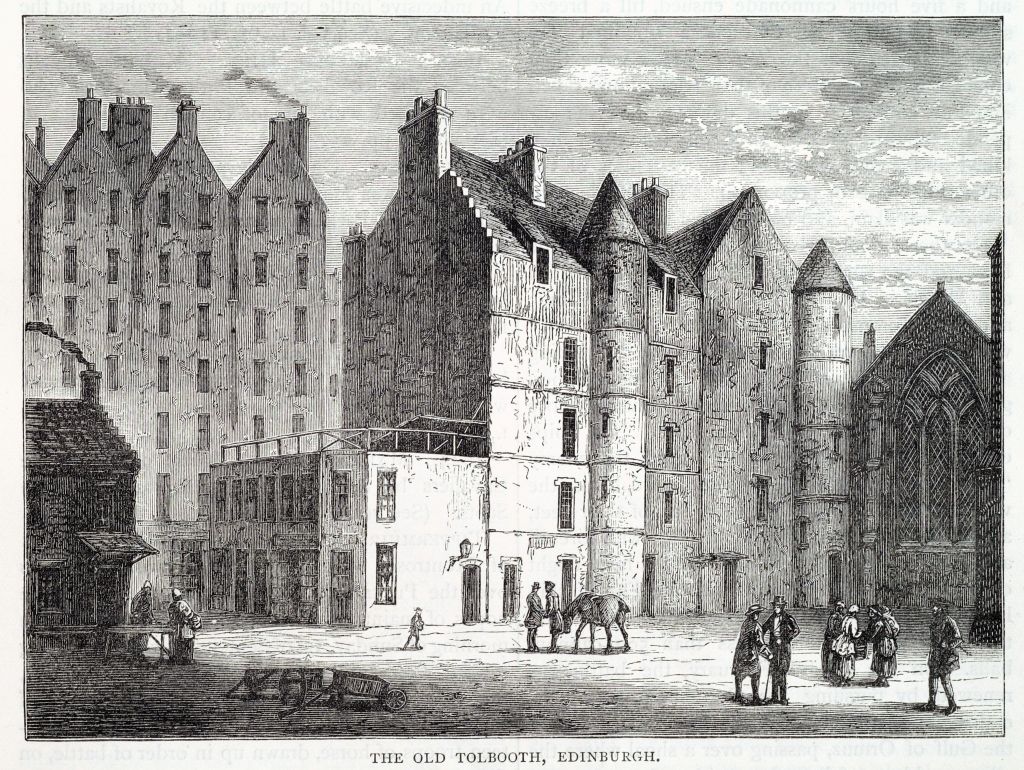
Alexander was soon arrested and taken to the Tolbooth Prison. On 31 March 1812 he stood trial and was convicted of Robbery and sentenced to transportation for life. He was transferred to the Prison Hulk Retribution at Woolwich and then to the convict transport Fortune, which sailed from England in December 1812.
The Fortune arrived in Sydney in June 1813 and her cargo of convicts were disposed of in a variety of ways. Alexander, aged 17, was sent to Edward Miles, an emancipist who was farming near present day Minto and who had applied to be assigned a servant.
At that moment, his fate hung in the balance. Many convicts failed to adapt to life in the colony. They ran away from their masters, committed further crimes and were destined to be flogged, sent to an iron gang or hanged. Something in Alexander however enabled him to successfully make the transition from wayward youth to obedient servant. He stayed with Edward Miles until 1819 when he obtained a Ticket of Leave which enabled him to work on his own account.
On 14 January 1822 Alexander married Sarah Warby, the 15 year old daughter of John Warby, an emancipist landholder living near Campbelltown. His father-in-law gave him 20 acres of land as a marriage portion and Alexander became a farmer.
Over the next twenty five years Alexander purchased some additional land and Sarah bore him twelve children, two of whom died in infancy but ten of whom thrived. However he outlived the birth of his youngest child by only a few months. He died on 28 February 1847 at the age of 50, probably after a lingering illness as he had time to make a will. He left some of the land he had acquired to Sarah for life and the remainder to his children, to come into their possession upon the youngest attaining the age of 21.
Alexander had been granted a Conditional Pardon in 1832 which restored to him all the rights of a free man save for the right to leave the colony and he died a well-respected citizen of Campbelltown. He was buried in the Presbyterian graveyard which had been established some years earlier on land he had donated to the church. Sarah would join him there forty five years later.
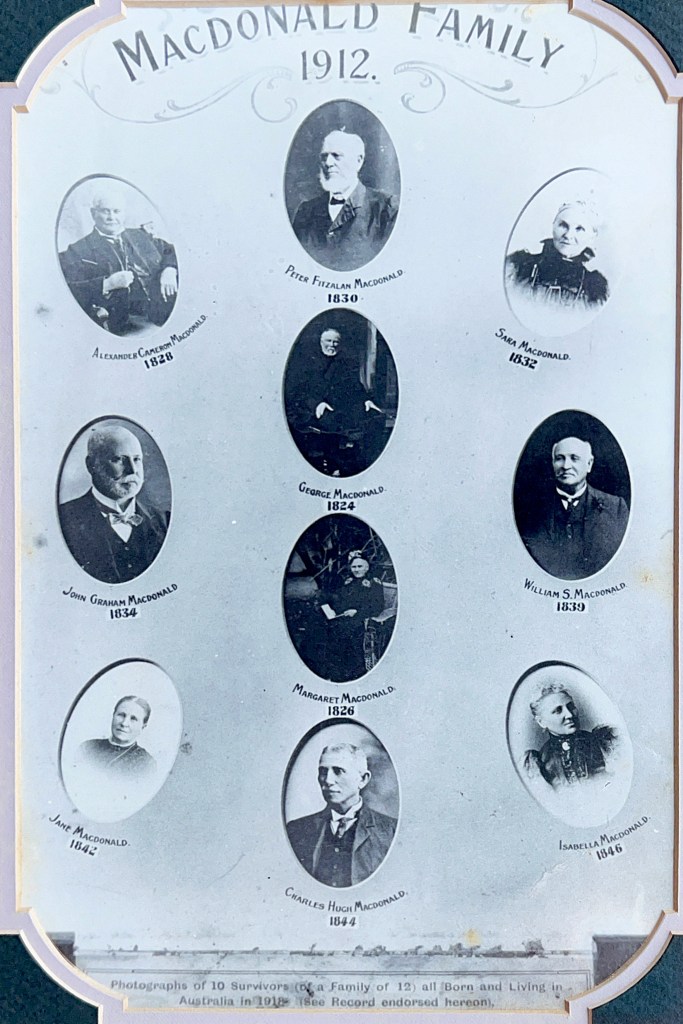
Alexander’s sons received the education he had been denied and some achieved renown. Alexander Cameron Macdonald (1828-1917), accountant, surveyor and geographer and Peter Fitzallan Macdonald (1830-1919), pastoralist, entrepreneur and politician, appear in the Australian Dictionary of Biography. John Graham Macdonald (1834–1918), explorer, pastoralist and police magistrate published a journal, ‘Expedition from Port Denison to the Gulf of Carpentaria and back.’ His remaining children became farmers or farmers wives and raised large families.
No likeness of Alexander exists, but he must look out at us from the faces of some of his children, who are depicted in a picture compiled in 1912, one hundred years after he was exiled from his home.
Select Bibliography
- Interviews conducted by Robert Smith Esquire, Magistrate of Edinburgh with Margaret Reid alias Macdonald alias White, Alexander Macdonald alias White and John Grant, 1812, various dates
- UK Prison Hulk Register & Letter Books, 19021849
- Petitions to the Governor from convicts for Mitigations of Sentences, Colonial Secretaries Papers, New South Wales, 1788-1856
- Sydney Monitor, 4 July 1829
- The Sydney Morning Herald, 3 March 1847
 Exploring the past
Leave a comment